Why Your Team Isn't Taking Ownership (And What You Might Be Missing)
Why Your Team Isn't Taking Ownership (And What You Might Be Missing)
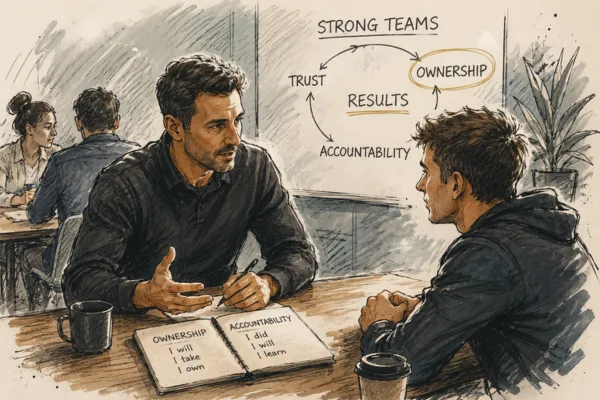
Teams rarely lack ownership because of attitude or motivation. The most common cause is leadership patterns that unintentionally remove the opportunity for ownership to develop. The three behaviours that most consistently block it are rescuing too quickly, over-explaining instead of asking, and absorbing problems back from the team. Changing these patterns produces more lasting results than any motivation strategy.
You've explained it clearly. You've set the expectations. You've followed up more times than you'd like to count.
And still, the task sits unfinished, the problem lands back on your desk, or the work gets done but only to the minimum required.
So you find yourself wondering: why won't my team just take ownership?
It's one of the most common frustrations I hear from leaders. And almost every time, the diagnosis is the same: there's something wrong with the people.
But after working with managers and leaders across industries, I've come to believe the ownership problem is rarely where leaders think it is.
The Most Expensive Misdiagnosis in Leadership
When a team lacks ownership, the instinct is to look at the team.
Are they disengaged? Unmotivated? Do they just not care?
Sometimes. But far more often, the issue isn't with the people. It's with the patterns the leader has unknowingly built around them.
Ownership can't be given through explanation. It can't be enforced through pressure. And it definitely can't survive in an environment where the leader consistently absorbs the problem the moment things get difficult.
If your team isn't taking ownership, the first honest question isn't: what's wrong with them?
It's: what have I been doing that's made it easier for them not to?
Three Leader Behaviours That Quietly Kill Ownership
1. Rescuing before they've had a chance to struggle
When a team member hits a wall, the fastest solution is usually for the leader to step in and solve it. It feels helpful. It keeps things moving. And in the short term, it works.
But every time a leader rescues, they send an invisible message: I don't trust you to figure this out. And more importantly, they remove the very experience the person needed to develop their own capability.
Ownership grows through struggle, not through smooth handovers.
The leader who always has the answer produces a team that always waits for one.
I learned this the hard way leading a dev team early in my career. When someone hit a problem, my instinct was to jump in with the answer straight away. But I knew impatience was the default, waiting for an answer always felt like the fastest path. I wanted them to build the muscle of thinking it through themselves.
So I made them wait. Not forever, just long enough.
More often than not, they'd come back with a solution before I needed to step in. It wasn't always the solution I would have landed on, but it was theirs. I'd build on it from there, refining it toward the standard, together.
It's a hard thing to do, because the standard we hold ourselves to took years to build. Our people need that same runway. Not because they're not capable, but because that's how capability is built.
2. Over-explaining instead of asking
Most leaders are strong communicators. They're good at articulating what needs to happen, why it matters, and how it should be done.
The problem is that clarity delivered by the leader rarely produces ownership in the team. It produces compliance.
Ownership is built when people arrive at the understanding themselves, when they've thought it through, wrestled with the problem, and reached their own conclusion. That process cannot be shortcutted by a well-worded explanation.
The shift from telling to asking is one of the hardest things for capable leaders to make. But it is one of the most important.
3. Carrying the problem back
Watch what happens when a team member brings a problem to you.
Do you leave the conversation with the problem, or do they?
If the answer is consistently you, if people bring you half-finished thinking and leave with a direction or solution you've provided, then ownership has been quietly transferred back to you every single time.
It often happens without either party noticing. The team member feels supported. The leader feels useful. And the pattern continues until the leader wonders why nothing seems to move without them.
What the Shift Actually Looks Like
Developing ownership in a team is not about lowering standards or withdrawing support.
It's about changing the nature of the support you offer.
Instead of: Here's what I think you should do. Try: What do you think the options are?
Instead of: Let me handle that. Try: What would you need to move this forward yourself?
Instead of absorbing the discomfort of watching someone struggle, sit in it with them. Present, but not rescuing.
None of this is passive leadership. It requires more patience, more discipline, and more restraint than simply solving the problem yourself. But the result is categorically different.
When people find their own answers, something shifts. They stop waiting to be told. They start thinking ahead. They bring solutions instead of problems. That is ownership, and it cannot be installed from the outside.
The Role You're Actually There to Play
The most common image of a strong leader is someone with answers. Someone decisive. Someone who knows what to do and moves fast.
That image isn't wrong for every context. But if your goal is a team that functions at a high level, one that doesn't require you to hold everything together, then the most important thing you can develop is not your own capability.
It's theirs.
Your job is not to solve every problem your team faces. Your job is to develop people who can solve problems without you.
That reframe changes everything: how you run meetings, how you respond to questions, how you handle performance conversations, and what you consider a successful week.
Ownership isn't something your team either has or doesn't have. It's something that grows, or doesn't, depending on the environment you build around them.
If you're working through an ownership challenge with your team, there are two ways to go deeper. If you're looking for support, community, and a structured development journey alongside other leaders, Visioneering is a leadership development program built for exactly that. If you need focused work on your specific organisation and team, coaching might be the better fit. Feel free to reach out and we can figure out which one makes sense.


